
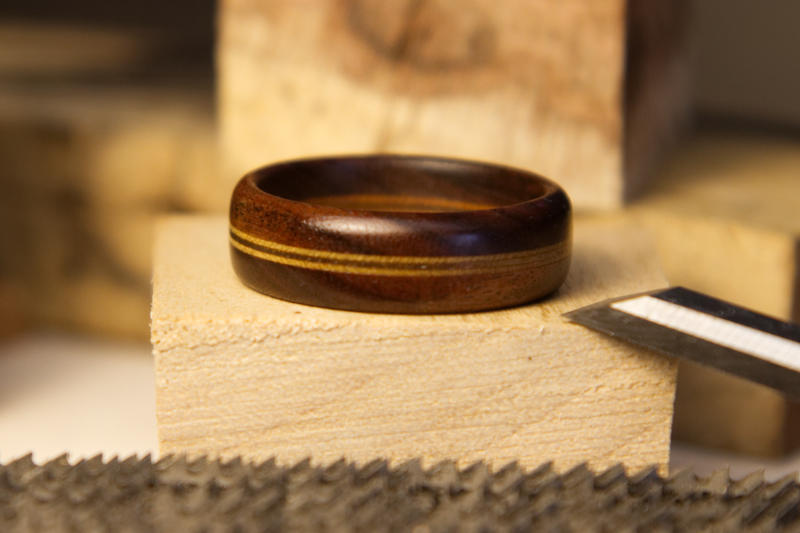
There are three major types, or methods of making wood rings. Each has their own unique pros and cons. Over time, I have made each of the three and have developed my own preferences for aesthetic and engineering reasons. If done right, I wouldn’t say any of them are wrong. It’s just a matter of what you are looking to achieve. The following is my run down of the differences with some of my own opinion mixed in.
Solid Wood Rings
A sold wood ring is pretty much what it sounds like. It’s made from a solid piece of wood. Most people start by making this kind of wood ring. This is how I got my start. You take a piece of wood, cut a hole into it, and shape it into a ring. Hey presto, you have a wood ring! But when you wear the ring for a bit, you quickly learn that there is more to it than this.
By itself, this is an inherently flawed way of making a wood ring. When you make a loop of solid wood, you have two sides with thin strips of wood grain. This creates weak points that are prone to break. With no other means to strengthen this, sold wood rings last a few weeks to a few months of wear, depending on the thickness.
There are ways to strengthen a solid wood ring to make it last years, decades, and beyond. These range from embedding a metal core to stabilizing the wood in epoxy. Once you do this, There are some key advantages of solid wood rings. In my opinion, aesthetics is the key advantage. Depending on how you cut the wood blank you start with, you get different patters of wood grain. Sometimes this reveals end grain on sides of the ring, sometimes it displays color variations around the ring. It’s a matter of preference, but in my opinion, it often makes for a more interesting looking ring.
Laminated Wood Rings
To overcome the weakness of solid wood rings (if you aren’t going to strengthen it using a core or something else), you can laminate several pieces of wood into one block and then shape your ring. This adds strength by crossing or alternating the grains between one layer and the next. Where one piece of wood has thin grain, the next layer has grain running length wise to strengthen it. In a sense, this creates a mesh of wood grains.
Laminated wood rings are best in two scenarios. First, they overcome the weakness issues with solid wood rings when no other structural support is used. This is best when creating a ring with natural finish. Second, laminating different wood types together can create some interesting designs. This can be used for a natural ring, or used as a blank for a metal core.
Bent Wood Rings
Some say this is the strongest and best way of making a wood ring. I think “best” is a matter of opinion. However, I will agree that when constructing a ring of wood only, this is the strongest method of making a wood ring. It’s also the method that creates the least waste.
Initially, it may be hard to wrap your mind around what a “bent wood” ring means. You basically take a thin strip of wood (often veneer), heat it with boiling water or steam, and then bend the wood into a circle. Yes, wood bends and is pliable under the right conditions. Once bent into a ring, you have long runs of continuous wood grain layered on top of one another. Thus it is very strong and adding any other strengthening method (metal core, etc.) is optional.
The disadvantage, in my opinion, is aesthetics. In general, long runs of continuous grain isn’t very interesting. Wood grain variations and changes in wood grain color add an interesting look to a ring. You often loose this with bent wood rings and have to add things like inlays to make the ring look interesting.
Additional Types of Rings
In addition to classifying rings based on the type of construction, you can also break them up into types of finish. In general, you have what I call “natural rings” and “finished rings”. Again, this is a matter of preference and is based on what kind of ring you prefer to wear and the look you are going for. Also longevity plays a factor when deciding.
Natural Rings
Natural rings either have no finish at all, or use a natural finish like bees wax. Typically, they are constructed of just wood and do not have a metal core or any kind of inlays (outside of laminated layering). They are sanded smooth to a super fine grit and as a result feel great against the skin. In my opinion, this is the biggest advantage of a natural finish; they just feel amazing to wear. The look is rather unique too and when polished with beeswax, can shine. You can even get beeswax polish that is scented with essential oils. For people who are allergic to metal rings, these are a great option.
There are several disadvantages to be aware of. Foremost, having wood against your skin can trigger allergies. This is especially true with exotic hardwoods. After personally having a reaction to a rosewood ring, I decided to no longer make natural rings out of exotics. The oils in some exotic hardwoods share the same properties as poison ivy and a larger percentage of the population is allergic. Beeswax does not properly seal the ring from this so it’s best to use exotics for finished rings. Domestic hardwoods are a much better choice for natural wood rings. The chance of an allergic reaction is slim, but still one should stop wearing if they see any issue.
In addition, natural rings will dull in their look over time. This can be brought back to shine with a quick application of beeswax. Exposure to water will damage the ring over time, so it’s recommended to remove the ring when washing or showering. While laminating the wood helps strengthen natural wood rings, it does not guarantee their longevity. While I have never had a laminated wood ring break or wear out yet, it is more possible than a finished ring with a metal core.
Finished Rings
“Finished rings” have some sort of material that seals (finishes) the wood and provides a shine. Typically I use cyanoacrylate (CA) as a finish as it is skin safe, durable, provides an excellent gloss, and completely seals the wood. With a proper seal, even exotic woods that would be a potential allergen in natural rings are completely safe as a finished ring.
Finished rings often have a metal core (stainless steel, titanium, etc.), but this is not always necessary. Laminated or bent wood rings are strong enough to not require a core and can have a finish on the inside and out. I personally prefer the feel of natural wood or metal against the skin so I rarely make rings with a finish on the inside, but the option is certainly available. Given the extra effort needed to finish the inside of the ring, it’s often just as easy to add a metal core when creating a ring with a finish. This adds extra strength, feels good against the skin, and adds an some aesthetics.
 Wood Fire Workshop