
If you’ve browsed a flea market, antique show, or tourist shop lately, you’ve likely seen an influx of “handmade” Damascus knives. They aren’t just available; they are everywhere, and at unbelievably cheap prices. As both a maker and a collector, this caught my attention. I’m not one to talk down on another person’s work (I love seeing what people create) but I wanted to explore the reality of these blades. Where do they come from, and technically speaking, are they any good?
The “Friend of a Friend” Phenomenon
I’ve watched these knives explode in popularity over the last few years. At a recent antique fair, they were everywhere by the hundreds. They all share the same DNA: advertised as “handmade,” almost always Damascus steel, and, most tellingly, bearing no maker’s mark whatsoever.
When you inquire about them, you usually get a rehearsed response: “My friend makes these.” Apparently, everyone has the same friend, because you’ll see the exact same styles at every booth. Prices range from $20 to $85. Anyone who has spent time in the knife community knows these are not custom prices. Something is amiss.
You’ll see “upscale” versions of this in tourist shops for $150 to $200. They might come in a box labeled “Damascus Brand”, but they still lack a true maker’s mark (or for that matter, any information about the blade). While these prices compete with mass-produced factory knives, they are still a far cry from the work of a dedicated custom maker.
The Source: Wazirabad, Pakistan
The absence of a maker’s mark is the “tell”. Anyone who takes pride in their craft wants their name on the blade. After a bit of digging, I found these exact knives being sold in bulk on sites like Alibaba. For as little as $4 a blade, you can order them by the thousands.
Most of these originate from Wazirabad, Pakistan, the country’s cutlery capital. In one sense, they are handmade. Wazirabad is a hub of a cottage industry consisting of thousands of small, informal family shops. While this technically supports small businesses abroad, the working conditions are far from Western standards. Safety gear is virtually non-existent. A noted study on the region’s industrial complex found that over 80% of workers suffered from respiratory issues due to poor ventilation and metal dust.
Furthermore, the craftsman sees very little of the profit. The “no mark” policy is intentional; it allows the middleman or the flea market vendor to sell you a story about their “maker friend” without a pesky logo getting in the way.
But Does It Cut?
“Is it good?” is a complicated question. Because these come from thousands of different tiny shops, quality varies wildly. However, compared to the standards you’d find at a major event like Blade Show, the answer is almost certainly “no”.
Beyond the lack of a personal connection to the maker, you don’t actually know what the steel is. These blades are often made from “found” scrap steel. This leads to two major issues:
- Low Rockwell Hardness (HRC): I’ve heard horror stories of blades testing in the 30s, barely harder than a piece of scrap iron. What does this mean to you? Lack of edge retention. The need to sharpen often. A poor heat treat that could result in a bent or broken blade.
- Corrosion: Because the steel composition is a mystery, they often rust if you even look at them funny. This is why they arrive slathered in heavy oil (often removed by the vendor before sale).
In some cases, it may not even be Damascus steel and instead has the pattern faked by etching it on.
The Bench Test
I bought one of these “specials” a year ago to see for myself.
- The Build: The ergonomics aren’t bad; it fits the hand well. However, the fit and finish are poor. The handle is natural horn scales, but there are visible scuffs and gaps between the tang and the scales.
- The Edge: Out of the box, the edge was laughable. I can hold the knife by the blade and lightly hammer the handle on wood without even a scratch to my hand. It’s slightly sharper than a butter knife. I hammered the edge into some hickory wood; it didn’t chip or roll, but mostly because it was barely sharp enough to bite into the wood.
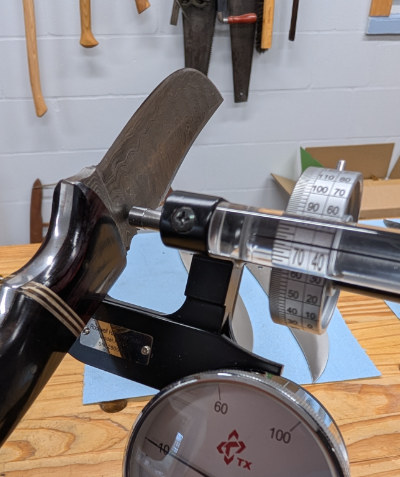
- The Science: I put the blade to my Rockwell tester. Near the tip, it hit 57 HRC, actually respectable for a budget knife. But as I moved toward the handle, the numbers plummeted into the mid-40s. This isn’t a “differential heat treat”; it’s a sign of an inconsistent, rushed process.
The Verdict
My assessment? Poor. If you want a hand made knife, save your money for one you can connect to a maker. If you want a good knife, save your money for a good brand name or custom maker. If you just want a $30 paperweight to tinker with, a flea market Damascus might satisfy your curiosity. But remember: you get exactly what you pay for.
 Wood Fire Workshop
Leave a comment