

I’m not writing this to tell you how to properly sharpen a knife. There are entire books, videos, and courses dedicated to the craft. It’s both an art and a science, and there’s no single “right” way. Every maker, professional, and enthusiast eventually develops their own spin on what works best.
Instead, this is about how NOT to sharpen a knife.
Specifically, I want to dispel a few persistent myths that are still surprisingly common (even among “professionals”) to help you avoid ruining a good blade or getting trapped in an endless cycle of dulling and grinding.
Understanding the Three Basic Edge Profiles
Before diving into what to avoid, let’s establish a baseline. We’re talking strictly about the cutting edge itself (the secondary bevel or edge bevel), not the primary grind on the sides of the blade.
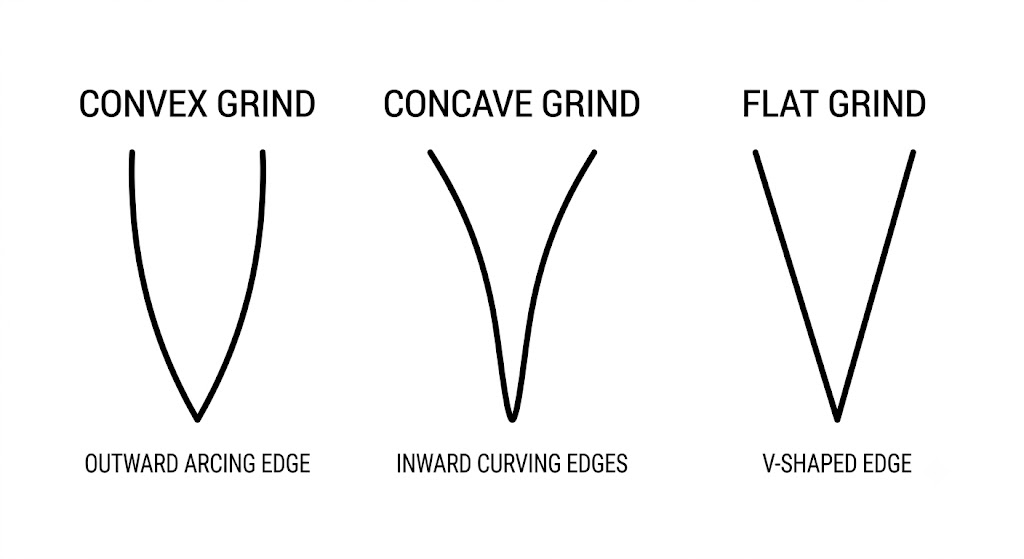
- V-Ground (Flat Bevel): The standard. Most factory knives and many custom blades feature a flat, V-shaped edge. It offers a great balance of sharpness, strength, and durability.
- Convex (Rounded Outward): Found primarily on select custom blades and heavy-use tools. While it might look less sharp on paper, a convex edge is exceptionally tough and often described as “deceptively sharp”.
- Concave (Hollow/Rounded Inward): Extremely thin behind the apex. It creates an insanely sharp edge, but at a severe cost to strength and long-term durability.
The “Spinning Wheels of Death”
At one time, it was popular for mobile “professional” sharpeners to mount commercial grinding machines in the back of a van and go door-to-door. These setups typically feature two counter-rotating abrasive wheels, where the blade is pulled through the point where the wheels meet.
A machine made by a major industrial manufacturer must be good, right? Wrong.
I was once in a knife-making class where the mere mention of these machines made a room full of experienced bladesmiths visibly cringe.
The Problem
These devices force a crude, aggressive concave grind onto the edge. Sure, it feels razor-sharp right out of the gate, making for an impressive demonstration. But that delicate, thin edge simply doesn’t last. A few days of heavy board work by a chef will leave it completely crushed.
This leads to a vicious cycle: the edge dulls rapidly, chipping or even snapping at the tip, requiring yet another visit to the sharpener. Great for the sharpener’s wallet; terrible for your knife.
What to Watch For
While less dominant than they used to be, you’ll still find these machines in use by some mobile services, hardware store sharpening counters, and cheap motorized pull-through appliances.
Rule of Thumb: If a sharpener plugs into the wall and requires you to drag the blade through a motorized slot with counter-rotating wheels, keep your good steel far away from it.
The Misunderstood “V-Sharpener”
Another frequent culprit is the manual pull-through V-sharpener (often featuring carbide V-notches or ceramic rods). These are aggressively marketed as easy, foolproof solutions for kitchens and outdoorsmen.
In theory, the concept makes sense: running a flat V-ground edge through a matching V-shaped notch should maintain the geometry. And if the angles match perfectly, they can produce an acceptable working edge in a pinch. For instance, many standard pocket knives feature a 20° edge angle per side, matching the 20° setting on standard field sharpeners.
The Trap
Damage occurs when there is an angle mismatch.
Kitchen cutlery, especially high-end chef knives, varies wildly in angle and geometry. If you drag a fine Japanese chef’s knife (which might feature a delicate 12° angle, or even a single bevel) through a generic 20° V-sharpener, you aren’t sharpening it, you’re actively hogging off metal, altering the bevel, and dulling the tool.
The Takeaway
A little knowledge saves a lot of steel:
- Know what to avoid: Be skeptical of automatic motorized slots and one-size-fits-all pull-through gadgets.
- Know your knife: Learn the factory edge angle, geometry, and steel type of your blades.
- Match your method: Always choose a sharpening system or service that allows you to match the specific angle and profile your knife was designed to hold.
 Wood Fire Workshop
Leave a comment